Opt-In/Opt-Out

This past Friday, April 6th, 2012, CBC marketplace ran an episode called The Busted Edition. You can see it here in its entirety.

In this episode, CBC turned its attention to World Vision Canada and how they recently notified their donors that their monthly gift will be upgraded from $35/month to $39/month due to increased costs, inflation, etc. All the donor had to do was contact World Vision and say they were ok with it or not.

But, here’s the part that CBC jumped on – if I, as a donor,  did nothing, they upgraded my gift automatically for me. I automatically “opted-in” by not responding.

This is a common and hated practice that banks, electricity and phone company’s take part in… but World Vision? One of Canada’s top charities?

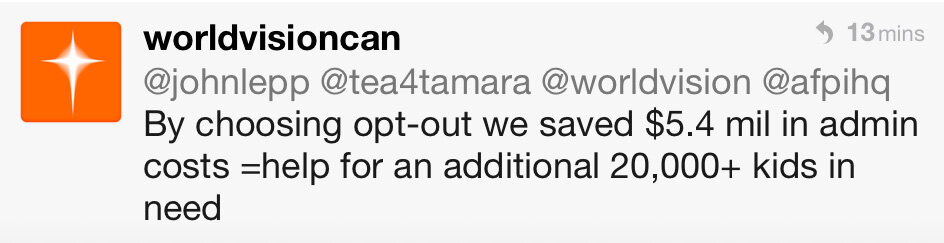
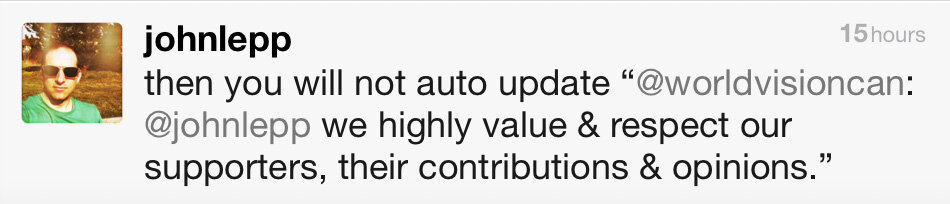
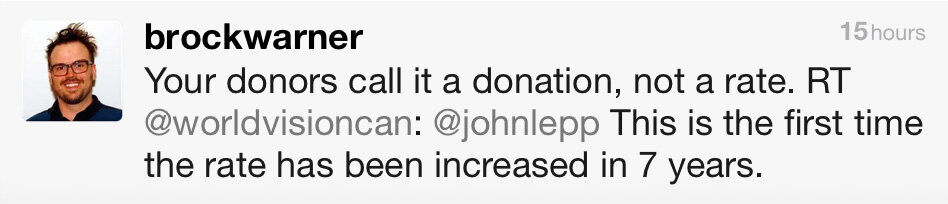
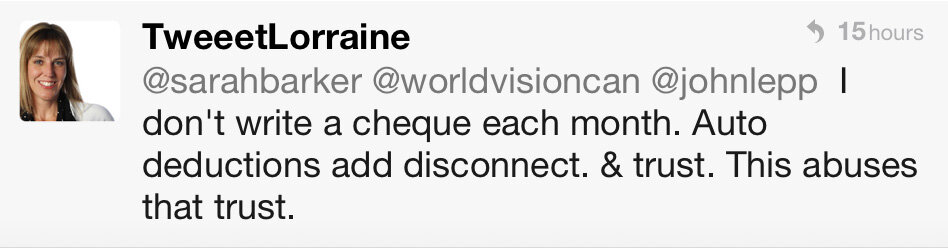
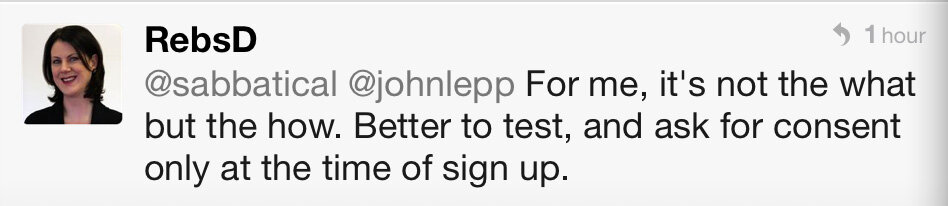
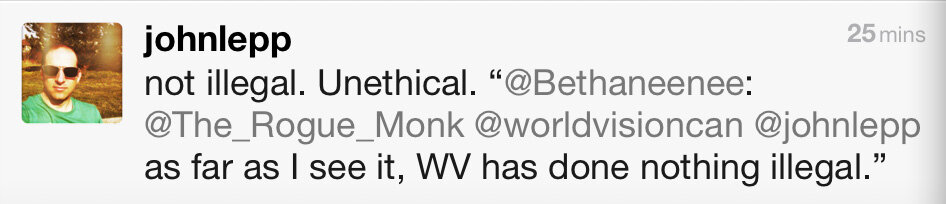
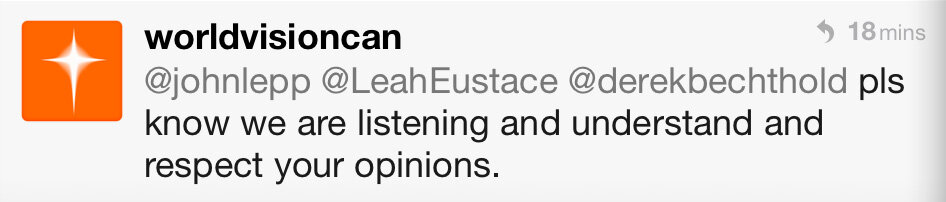
I tweeted World Vision about it and not only was astounded by their answers but it was clear they didn’t see the problem – they still don’t.

Here is a selection of tweets as the evening progressed.


I’m not arguing that World Vision doesn’t do good work, or that they are justified in raising (ehm) their “rates”.

The issue is that great donor centered fundraising means that you allow your donors opt in to EVERYTHING. Every increases in donations, your communications, every point and type of contact. (I’m obviously not talking about acquisition.)

Just because I don’t call or mail or ask that I do not want it, doesn’t mean I’m optting in.

I hope that World Vision and every other charity who takes part in this practice gives their head a shake and reconsiders their “policy”.

I had a final laugh as someone tweeted me, repeatedly, finally asking what my problem was and who do I work for?

My answer: “Donors.”

Put their needs before yours regardless of your policies and justifications.

What do you think?

27 Responses to “Opt-In/Opt-Out”

  1. David Love April 17, 2012 11:41 am #

    Way to stir the pot Agent John. Great stuff. Now we have more people thinking about donors.

    But let’s not make this like Earthg Hour. “We’ll be good for 60 minutes and then turn the lights back on.”

    Let’s use this to promise to put donors at the centre of all we do.

    Let’s write the word on our morning mirror!

  2. A Martin April 16, 2012 2:46 pm #

    I was a WV supporter in the UK but I quit after they automatically increased my regular giving. Of particular concern to me was that the only way to opt out of the increase was to telephone – I couldn’t even email to opt out. I emailed them to explain why I was cancelling my giving, but got an email back after some time asking if I’d overlooked my payments by mistake! When I explained again, they thanked me for past support (of the wrong child) and at no point addressed the issues I’d raised in relation to opt-out increases. I won’t support them again, nor will I support any other charity that tries this strategy.

    • John Lepp April 16, 2012 6:52 pm #

      very very disappointing… thanks for commenting and sharing your story!

  3. Sonya Swiridjuk April 12, 2012 2:52 pm #

    John, thanks very much for posting Caroline Riseboro’s response to you from World Vision Canada. I took the liberty of sharing it with my fundraising students at Humber College yesterday; they’re currently studying stewardship and donor relationship management with me, and your post was a timely supplemental to the passionate debate Ken Wyman had in his class on this “rate increase” issue after the students watched the CBC Marketplace segment on Tuesday. WVC’s reply is a great example of good stewardship in action – a timely, thorough and detailed response to a donor/propect’s concerns. Conversely, the “Dear Friend” letter, as kindly shared by Christina Attard and also received by Margaux Smith, is a strong example of poor stewardship – for all the reasons already noted by Christina, Margaux, yourself and other commentators. So thank you for this engaging online discussion which has added to the “real world” learning of new fundraisers entering our profession. I’ve encouraged my class to follow it (and more!) on AoG’s Facebook page and Twitter feed.

    • John Lepp April 12, 2012 5:33 pm #

      Thank you Sonya for sharing this. Apparently there are three minds in regards to this issue. One – that has a real problem with this tactic – regardless of the money it saved or made, two – that has no real qualms and issue with it – just part of the business and three – that just don’t care. I’m most enthusiastic to the conversation and thoughtfulness it has generated and so long as we have made someone take an extra second and think about what is best for their donors – my job here is done. Thanks for your support Sonya!

    • Christina Attard April 12, 2012 5:54 pm #

      Thanks, Sonya for your comment here and for sharing the discussion and some of my thoughts as a donor on this with fundraisers coming into the profession. I posted the letter in the first place as a way to begin a conversation about donor-centred fundraising and stewardship, so I’m pleased that I could make a contribution to that in your class.

      I also appreciated Caroline Riseboro’s response on the blog and very much respect that WVC is engaging in the conversation. I also respect that this charity is trying out new(?) fundraising techniques, albeit, in my opinion, they didn’t get it right this time, but I appreciate their investment in innovation.

      My hope is that, as a donor to WVC, I will hear from the organization personally. We often speak in our professional circle that responding frankly and honestly to concerns from our donors often generates great loyalty. (and as I mentioned on my blog, I did pick up the phone and try to get through to the development office to express my concerns) Unfortunately, the time and effort it will take to be in touch with people like me as a result of this will diminish the administrative savings that seem to have been the main concern here in the first place. However, the investment in the relationship with their donors will likely pay great dividends for this charity.

      Look forward to seeing how this “case study” turns out in the end.

  4. Christina Attard April 11, 2012 8:07 pm #

    I watched the CBC coverage, I’ve been following the blogs and the tweets and I want to speak here as a donor rather than as a professional fundraiser. I received that letter from World Vision. I blogged about it from the perspective of a donor. Something in my spidey senses told me this didn’t sit well with me. I didn’t name names in the original blog post in order to avoid pointing fingers, but it seems like the discussion is open now.

    Here were some of my thoughts from a donor-centred perspective as well as a photo of the letter that I received as a donor in case anyone is interested in a close-up look.

    http://www.christinaattard.com/1/post/2012/01/dear-friend.html

    My biggest problem with the opt-out strategy was actually more that they addressed me, a long-time donor, as “Dear Friend” rather than using a more personalized solicitation.

    I was very pleased that Mark Climie-Elliott at AFP was asked for an opinion and represented, as he said, the major of charities that don’t solicit this way, well.

    • Margaux Smith April 11, 2012 11:13 pm #

      I remember that letter well Christina, and am shocked to hear that it’s the same one! That’s the letter that put a bad taste in my mouth in regards to opt-outs in the first place. I really like what Caroline has said about World Vision’s methods but the donor focused attitude doesn’t seem to match when I see a lack of personalization and the fact that the increase is actually $48/year. As a donor of simple means, that seems quite high to me. If you want an extra $48 from me, you definitely have to show that you know my name…

  5. Rebekah Basinger April 11, 2012 5:55 pm #

    The way World Vision Canada has gone about raising more money, “charging” it donor’s “bills” unless told not to, reinforces the worry I heard from many folks (especially those who aren’t completely comfortable with online giving) have about giving via automatic transfer of funds. To have a monthly gift amount automatically increased unless the donor opts out assumes a high level of attention to everything a charity is communicating.

    Yes, this was an efficient move by WVC, but not a very helpful one for the larger world of faith-based philanthropy. I hope others do not follow this lead.

  6. ephraim gopin April 11, 2012 4:20 pm #

    John-
    I have been watching this play out on Twitter and was extremely interested to read Caroline Riseboro’s response above.

    Caroline- not sure if you’ll see this but if you do…
    I’m interested in two things
    1) “We have been alerting our donors to this upcoming increase for the last year, through numerous communications materials and method”
    what was the response rate to these communications? i.e. what % of donors responded to these various forms of communications? I know the goal was to make sure this didn’t suddenly “fall out of the sky” on them- but curious how many donors took action in advance of the final letter
    2) I’d be very interested, if you’re allowed to share, to know what % of donors opted-out, % that sent you their approval of the donation hike or % that were not in touch at all?
    I think that these numbers would be very telling for both those who criticized your org AND for your org going forward. As you mentioned above “we are open to reconsidering the op-out method moving forward”

    I wish your organization continued success with the work you are doing,
    Ephraim (Israel)

    • Caroline Riseboro April 11, 2012 9:08 pm #

      Thanks for your question Ephraim. To date, we have had about 13% of Sponsors who have asked to keep their rate at the current level. Again, Sponsors have been very understanding of the increase, but many for financial reasons, have decided to opt-out. Trust this helps.

  7. John Lepp April 11, 2012 3:18 pm #

    Caroline, let me thank you for taking the time to talk to me and more importantly take time to comment on this issue. I think it’s really important that you took the time to share the in’s and out’s of your decision making. At the end of the day, as I said to you, for some of us, fundraising is about more than money. It’s about real people. In your case we are talking about children who need help from donors that care – a lot. I applaud your thoughts and really hope you continue to gut check your policies to make sure they meet the needs of your donors, sometimes before they meet your own. Thank you! john

  8. Caroline Riseboro April 11, 2012 2:31 pm #

    John:

    It was a pleasure speaking to you yesterday about the Marketplace airing and thank you for encouraging me to post on your blog.

    As I mentioned yesterday, we are distressed by the Marketplace segment on the recent World Vision Sponsorship rate increase. We found the piece misinformed, inaccurate and by no means representative of the diligence that was undertaken before making this decision. I want to take a moment to give the facts that were not presented in Marketplace’s segment.

    The reality is that costs have been steadily rising in all of the communities where World Vision works – some by up to 40%. We have not increased the rate of Child Sponsorship for over 7 years, but can no longer deliver the same quality and care of children that donors expect from us. Nonetheless, before making the decision to use an Opt-out approach, we undertook the following actions (none of which were highlighted on Marketplace):

    1) First and foremost, we considered the feedback we have received from our donors. They have told us time and time again that they want to see the most amount possible of their donation to go towards helping children, not on administrative costs. Using an opt-out approached allowed World Vision to save $5.4 million in administrative costs, helping an additional 20,000 children. We did this in respect of the wishes of our donors who have been clear that this is their preference. We have received strong support from our donors in taking this approach.

    2) We have been alerting our donors to this upcoming increase for the last year, through numerous communications materials and methods. We have asking them simply call us, contact us, mail us, and we would be pleased to keep their rate at the current amount. In fact, the night of the Marketplace airing, we received a suprising number of calls from donors expressing their upset with the Marketplace segment because they had received many of these communications (some choosing to opt-out) and believed World Vision was put in an unfair light.

    3) When donors sign-up for a Child Sponsorship, we mention to them that their rate may increase. If they do not want their rate to ever increase, they can let us know when they first sign-up and we will make sure to never increase their rate.

    4) We also conferred with legal experts and association experts before choosing the opt-out method to ensure it was fully compliant and permissible. As many of you may be aware, other charitable organizations chose this method in the past and will likely choose it again in the future.

    World Vision’s intention in choosing the opt-out method was two-fold. Firstly, it was about respecting the wishes of our valued donors who have been clear with us in wanting to see as much money go towards helping children as possible. Secondly, it was about enuring that more children around the world have the opportunity to see their dreams become a reality, and not have to deal with the life-threatening, life-crippling effects of poverty. Nevertheless, we are glad that people have weighed-in with their opinions, and we are open to reconsidering the op-out method moving forward. At the end of the day, we want to do our best for children and welcome the comments and advice of Canadians.

    Thanks again John for our conversation, and I hope you and your readers find this helpful.

    Warm regards,
    Caroline Riseboro
    VP, Public Affairs
    World Vision Canada

  9. John Lepp April 10, 2012 12:50 pm #

    thank YOU Paul for that incredibly thoughtful response to the post. And that’s why we love you!

  10. Paul Nazareth April 10, 2012 3:05 am #

    My quick caveat to my comments: I am a fundraising bigot – no matter how much I study and am taught about good fundraising the donor in me is like the incredible Hulk. When you call me at dinner, bother me on the street, try to give-wash transactions into altruism and break the rules of decent value expectation -that donor overrules common sense and smashes everything in it’s path.

    I was sitting on my couch and happened to catch this story live – I turned off my TV after and thought about it for a while. And had to say I was proud of the Association of Fundraising Professionals for standing up for ethical practice on this issue. I AM tired though of this kind of “charity scandal” style journalism, all too easy to go after the big neon orange machine that is World Vision. But that dumb donor in me says, “this is offside!” I know money was saved but if it is cheaper to save admin costs by not putting in a “check brake fluid” light in a car because “they’re going to find out sooner or later” – save the cost and put in the light! Exaggeration of course, but the fundraising profession is in a war for trust right now, we can’t afford tactics like this.

    Now let me tell you why I’m an idiot.

    I don’t raise cold hard cash to save children. When people are faced with costs savings and the ability to help more kids, I can understand them doing crazy stuff like this. When I was in my late teens and becoming my own donor I sent an angry letter to Covenant House, a charity to help street kids. I expressed how angry I was at all their direct mail. They sent me a note back saying, look at the numbers, it works! So keep holding your nose and donate, we’re doing good work, we’re smart enough to make tons of money. The reason I’m in the fundraising game is because I don’t like this part of the machine – I know it works. But I can still hate it.

    Also, I respect that if anything World Vision is in the conversation.

    ( Ps. In a few months, we’re going to me WVC staff at a conference, we’re going to ask about the result. I know it will be, virtually no complaints and almost total participation. Like much of life, that person who says “I’m never going to donate to charity again” was never really much of a donor in the first place and we look stupid. )

  11. John Lepp April 9, 2012 10:14 pm #

    Thanks everyone – love some of the extra discussion and dialogue here – and I am keenly aware my approach and thoughts at times can be idealistic and somewhat naive but I guess I’m the type of fundraiser at the end of day who doesn’t believe that fundraising is all about money… Just because “it works” doesn’t mean we have to always do it – especially at the risk of angering and alienating donors. Thanks Jono and Margaux for your other insights…

  12. Margaux Smith April 9, 2012 8:37 pm #

    So last month I was at Fundraising Ireland and met a very nice gentleman who may or may not be a principle at a large UK consultancy that may or may not have its ties somewhere in this comment thread already. He was asking me about my job and brought up the idea of an opt-out letter. I was astounded!! I said I would never write a letter like that! I’d quit! I’d refuse!!

    He laughed and explained to me that these letters, if crafted with care and respect, work amazingly well for child sponsorship charities (he specified this group almost exclusively). He used them with clients often and the charities have minimal complaints and around 95% opt-ins. Even after the next increased payments come out of the donors’ accounts, the opt-in rate remains around 90% and those 5% just ask to opt-out of the increase, but continue to give.

    I have to admit, that kind of blew me away. The letters and communications were crafted in a respectful, donor-focused, story-focused enough way that donors weren’t mad. I even began to think that my favourite charities might be able to get away with it on me….

    I still feel funny about the idea but you have to admit, from the point of view of raising money, a 90% participation rate on a DM piece is kind of hard to resist.

    I suspect you’ll feel this is not the point, but the part that gave me pause, was that the donors weren’t mad. So maybe there is a way to do this right…

  13. Jonathon Grapsas April 9, 2012 8:23 pm #

    I think we need to be careful not to miss the point here.

    Without seeing the letter they sent its difficult to comment, although their tweets help paint some of the picture and it seems the execution is the issue. As Rebecca Davies tweeted “its not the what, but the how”.

    In other words their explanation of the upgrading and then subsequently how they’ve dealt with responses.

    I have absolutely no issue with auto-upgrading. It’s a tried (and tested) practice that works, and raises millions of dollars for charities. As WV have (poorly) explained.

    However it should only ever form part of an upgrade strategy, it shouldn’t be the upgrade strategy. In other words a proactive upgrade program should form the basis of the upgrade approach: phoned once a year, supported by a mail/email program that asks, and for an org this size the program would likely be rolling (monthly). Meaning every supporter is asked a minimum of once a year for an upgrade.

    For those supporters who can’t be contacted by phone or perhaps haven’t upgraded in a period of time (say 2-3 years) then and only then should an auto upgrade be considered.

    One caveat is that it should only be done by orgs have in place a brilliant donor care program. Lots of regular feedback, bringing beneficiary stories closer to you, stopping and saying thank you without asking etc.

    If then you’re confident your donor care rocks and you’ve got in place a proactive, regular upgrade cycle (and you have supporters who haven’t upgraded) auto upgrades should be something you do.

    And it should be opt out (bearing in mind all of the things I’ve said above). However I’d urge charities to send at least two, perhaps even three notifications. A fantastic, story led letter (email etc) that explains the impact your work is having, but how the need continues – and is greater. That means we need further support and are asking you to allow us to increase your monthly gift.

    If this is done properly then in my experience only a very small % of people will actually either not upgrade, or even cancel. The huge % that will upgrade (around 80%, even higher), plus those who upgrade by more than the % you suggested will far outweigh any potential loss. As WV attempted to (very badly) explain. I am not surprised they make $5m a year by doing this, but sadly if they did this better it would be a lot more effective. And that means many more kids helped (not millions saved on admin costs).

    So the issue for me isn’t the practice of auto upgrades – it isn’t new and isn’t unethical. It was just implemented in a very sloppy way.

    The issue I don’t believe is opt in versus opt out. If WV’s donor care was so bloody good then you wouldn’t even care about whether they asked you to opt in or out. But clearly it isn’t, hence the frustration.

    Let’s not send the wrong message here. Upgrading really well does potentially mean a shed-load more income for charities. And stripped down, that means shed-loads more kids helped, research funded, or natural heritage protected. Let’s not lose sight of that.

  14. Sonya Swiridjuk April 9, 2012 8:13 pm #

    This is all very interesting! Thanks for sharing, John and fellow Agents of Good. I’ll throw a few other things in the discussion mix: 1) Perhaps World Vision Canada is taking their direction from World Vision International; 2) Maybe WVC is getting their advice from a commercial agency that’s clueless about charitable giving; and 3) Maybe WVC is doing this against their agency’s advice. I’m sure we’ll all be staying tuned to see how this unfolds!

  15. Revsimmy April 9, 2012 8:04 pm #

    Although I support WV from the UK rather than Canada, the fact that they seem unable to see the problem, even when pointed out to them, is rather disturbing. I shall be keeping a closer eye on my statements and communications from WV in future. Some strange thinking seems to have got into the organisation from somewhere, and while existing donors MIGHT let it ride, the damage to WV’s reputation could seriously put off new donors.

  16. John Lepp April 9, 2012 7:14 pm #

    thanks Beth and Brock for your comments… and yes, still waiting for WV to actually acknowledge their opt in or opt out process on this. I have a feeling I will be waiting a long time.

  17. Brock Warner April 9, 2012 7:10 pm #

    Remember when if you needed to raise money, you actually asked for it? Seems more practical than just taking it directly from your donor’s bank account and hope most of them don’t notice or care.

  18. Beth Ann Locke April 9, 2012 5:58 pm #

    Missed all the twitter noise and find this pretty shocking! I guess one could change all the cheques from ending with 0 to ending with 6 just as easily, and as sneakily.

    Having a conversation with donors (even as a group but with a one-to-one feel, as one must with the monthly donor group, is what needed to happen here. It is a real pity that they didn’t take the donor-centered approach. In many areas of our lives, one is compelled legally to “opt-in” (think of mailing lists, etc.) and it is surprising that where money, on a monthly basis, doesn’t reach the same standard, based on the needs and care of the donor.

    Thanks for shedding some light on this, John!

  19. John Lepp April 9, 2012 5:02 pm #

    Thanks Bernard. I doubt a fundraiser among us would disagree about asking for more donations because you need the money. I agree with you, calling it “rates”, being directed to a “customer service” page and being charged the increase automatically if i don’t respond to the notifications – that’s what stinks to high heaven with all of this. Am i dealing with a charity or a bank… very, very disappointed.

  20. Bernard Ross April 9, 2012 3:48 pm #

    Worried about the whole language of WV in this. They talk of ‘rates increase’ on a web-page called ‘customer service.’ And the discussion is of ‘opt in’ v ‘opt out’ and saving ‘administration costs.’

    Plus if you haven’t raised your ‘rates’ in 7 years seems to you’re not paying paying attention to the fact the poor are getting poorer. Sounds like WV is being a bit lazy at best… if you need more money to deliver your mission tell your donors that… ask them to raise their gift even more… (Look at how Planned Parenthood donors responded when asked to step up.)

    Short term this seems to work

Trackbacks/Pingbacks

  1. YOU, Celebrating Philanthropy « YOU the fundraiser - June 19, 2012

    [...] ago when an organization sent out a Tweet in regards to its opt in/opt out option for donors. (Click here for the tweets, the story and the follow up by the organization, very well summarized by… In the tweet, the language refers to a “rate” (which is the organizations monthly donation [...]

Leave a Reply